
Our meeting place
The line to reach my mother’s casket was about an hour and a half long.
The people just kept coming. Telling us different versions of the same story.
Your mom was there for me. She was one-of-a-kind.
Your mom helped me through a difficult time. She never gave up on me.
Your mom always remembered. She made sure I felt loved.
She was there. Always.
I don’t mean physically, not always. My mom’s physical body wasn’t what you’d consider average and able. She was riddled with joint issues, arthritis and various other things. She struggled with her weight, her confidence, her pain.
Yet still, they talked about her smile, her kindness, her ability to lift them up with her faith, her listening ear and empathetic heart. And how proud she was of her children and grandchildren. Again and again, people told us that our mother had made them feel cared for.
Some of them had seen her recently. Some hadn’t spoken to her in months or years. It didn’t matter.
Once my mom brought someone into her life, she kept them there.
She cast an incredibly wide net.
She held onto the details of people’s lives long after someone else might have forgotten. The net was built one phone call, birthday card, prayer and quiet act of attention at a time.
And after she died, it was that net that held us.
My sisters and our respective families set up camp with my dad at the house he and mom shared for more than half of their 49 years together. It was a non-stop open house for the next six days.
Food kept arriving. The kitchen kept getting cleaned. The garbage kept going out.
The hugs, the tears, the outpouring of support and love. Every message, flower or card that came to us, held us together. People fed us, sat with us and took things from our hands when we could no longer carry them. We had everything we didn’t know we needed.
This community didn’t suddenly appear because mom died.
It appeared because, for decades, our parents had appeared for them.
Standing inside that outpouring of care, I began to understand something about my mom, something maybe I always knew but never fully saw. Which led me to understand something about myself.
My mother built community all her life.
And so do I.
I spent much of my life focused on the ways my mom and I were different. Our relationship wasn’t naturally easy. Of my siblings and me, it’s safe to say I had the most strained relationship with her.
Some of that strain came from the years of my brother’s addiction and the different ways we tried to survive it. Some came from the expectations she carried about who I was supposed to be, expectations I’m not convinced were even entirely hers.
They came from her family, her faith, her generation and the world that taught her what a daughter was supposed to look and act like. They also came from being a mother without any kind of roadmap, which of course I understand much better now.
Parenthood became the place where my mom and I finally learned to meet.
It was also the thing that forced me to stop living as the person I thought I was supposed to be.
Our love language became the kids. Every morning since 2019, I sent a photo of my kids being sweet, or ridiculous, or simply looking older than they did the day before. Just a small piece of ordinary life that connected us.
Becoming a mama changed the way I saw my own. It didn’t erase the difficult parts of our relationship or rewrite our history, but it did give me perspective.
I began to understand the constant weight of motherhood. The worrying, anticipating, remembering and carrying. The impossible expectation that you should somehow know what your children need, while maintaining your own career, house, relationships and, oh yes, yourself.
My mom impressively carried all of that somehow. I wasn’t built that way and I wasn’t prepared for it, but for the first time in a long (long) time, I looked to her for guidance.
I’m not sure my mom knew how to guide me toward myself in the way I needed until I was a mom.
To be fair, I’m not convinced I would have listened if she had. The truth I came to understand is that nobody ever showed her how to guide a child like me. She knew how to support the kind of life she recognized. She knew the conventional markers of adulthood and success. But she didn’t have the language for my neurodivergence. She didn’t understand why certain things were difficult for me or why the expected path just Never. Seemed. To. Fit.
I mean, neither did I.
And then in 2019, I became a mother.
The next day, my brother died.
Motherhood and grief arrived almost simultaneously, and I had no choice but to begin figuring myself out. It wasn’t easy, and I had no idea where I was going. But I knew I had to find my way if I had any chance of being there for my family.
Six years, a rock solid partner. A great therapist. My brilliant sisters. A handful of friends who stuck by me. Five hundred hours of yoga teacher training. Endless coffee dates with people who just got me. A business partner I never knew I needed. Learning about my neurodivergence and dropping the stigma. Unlearning the belief that I had to force myself into a shape that made sense to everyone else.
And an understanding of what a privilege it is to have time, access, funds and support for all of the above.
It’s not the kind of journey you stop once you start.
But I did not find myself alone.
I found myself through other people. Through the ones who listened, reflected things back to me, made room for the mess and stayed long enough for me to recognize myself.
Community was not simply the work waiting for me at the end of that journey.
It was how I got there.
I gave myself permission to work differently, think differently and build a life around who I actually was. Not who I was supposed to be. I began creating for other people what others had created for me: places to feel understood, supported and part of something.
Community became the thread connecting nearly everything I did.
Ghost Market. Elevate Together. A.MAT. Yoga. Storytelling.
Making spaces where people could meet and feel like the authentic version of themselves. Helping people recognize what they had to offer. Taking scattered people, ideas and resources and finding a way to bring them together.
It was the first time in my life that I was following what made sense to me.
This whole time, I thought I was building something entirely my own. Because I didn’t realize how my mom built community differently.
She never created an organization or developed a community program. She didn’t organize markets, have a yoga practice or build strategies around connection and belonging.
She did it through family and faith, friendships and phone calls. She remembered birthdays and anniversaries. And the letters. So many letters.
She checked in. She held onto the details of their lives long after someone else might have forgotten.
She maintained belonging across time. I create spaces where belonging could begin.
But we both noticed the distance between people and instinctively tried to close it.
Different tools. Different language. The same instinct.
Pay attention.
Remember what matters to people.
Bring them together.
Make room.
Help where you can.
I didn’t recognize the connection at that time, of course. But guess who was my biggest supporter once I found my way? My ma.
She may not have always known how to get me where I needed to go, but when I arrived, she saw me.
She celebrated every success. She showed up. She listened while I talked through whatever I was building next. She told people what I was doing, probably with far more confidence than I felt while doing it.
She was so proud of me. Not because I had finally become the version of me she once expected, but because she saw me become the best version of myself.
In her later years, the learning began moving in both directions.
My mom had lived through more than most people should have to endure. She spent 20 years loving my brother through addiction and then survived losing him. She lived in a body shaped by pain, joint problems, infections and surgery after surgery. Then when my dad had a massive stroke in 2022 and developed severe aphasia, she made it her life to lift him up every day.
Through all of it, she continued putting other people first.
I was operations. I helped with the practical things. Doctor’s appointments. Hospital conversations. Logistics. Figuring out what had to happen next. I became the person she called when something needed to be understood or handled.
July 11, 2026
But on my journey, as I learned to offer myself more grace, I also tried to give some of that grace to her. I reminded her to be gentler with herself. I tried to help her understand that she was allowed to need things, change her mind and make some room in her life for herself.
This last summer together, you could see it.
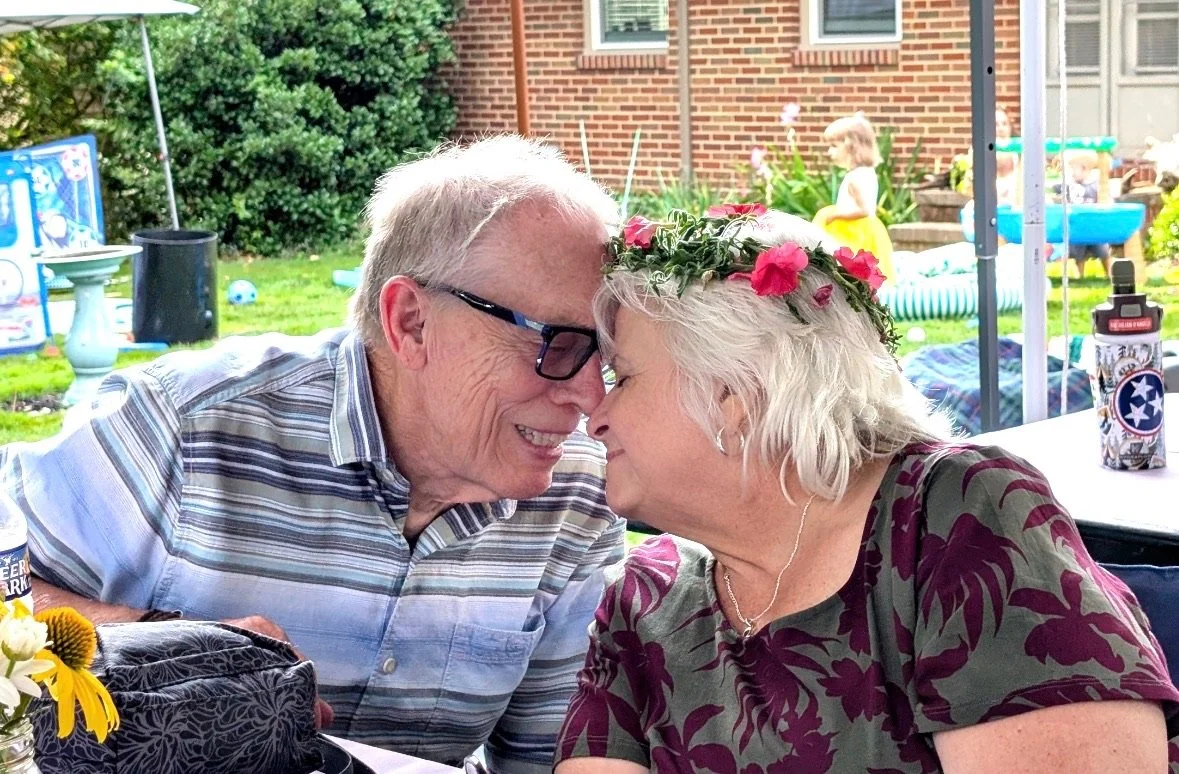
She let us throw her a garden party for her 70th birthday. I say “let us” because she was always more comfortable celebrating someone else. But that day, she allowed herself to receive some of the attention and love she had spent her life giving away.
She was so beautiful.
Even at 70, my mom was still learning and unlearning, and coming into her own.
After she died, my sister found a note in her phone, that reads to me as a mission statement:
“Perhaps we aren’t supposed to know right now? There are things to be revealed and a purpose. We need to trust this and work on our humanity and compassion toward all people. I believe in a natural goodness of people. Spread love and support is what I need to do.”
My mother and I did not have the same God. We did not use the same language. We did not take the same road.
But we believed in people in much the same way.
Her faith told her to spread love and support, and something in me kept creating places where people could find both.
Perhaps that’s why the community surrounding us after her death felt so familiar.
I was grieving inside the kind of thing I had spent years trying to build.
I thought carrying on my mother’s legacy would be something we had to figure out after she died. Another impossible task sitting beside the grief, the paperwork, caring for dad and his broken heart, and learning how to move through a world in which my mother no longer existed.
But her legacy isn’t something I have to invent or find.
It’s already here.
It’s in every person I connect. It’s in the way I teach and mother my own kids. In every space I create where people can feel seen. It’s in every room where someone walks in alone and leaves feeling part of something.
It’s in the work I was already doing before I understood where that instinct came from.
That does not make losing her okay.
It doesn’t explain why she was taken so quickly and unexpectedly, just as we finally found our meeting place. And it certainly doesn’t change the fact that she won’t see my children grow.
It doesn’t change my mornings, when I instinctively reach to send her a photo of the kids.
It will never change the fact that she’s no longer here.
But I am beginning to understand where all of the love goes.
